
 by
by 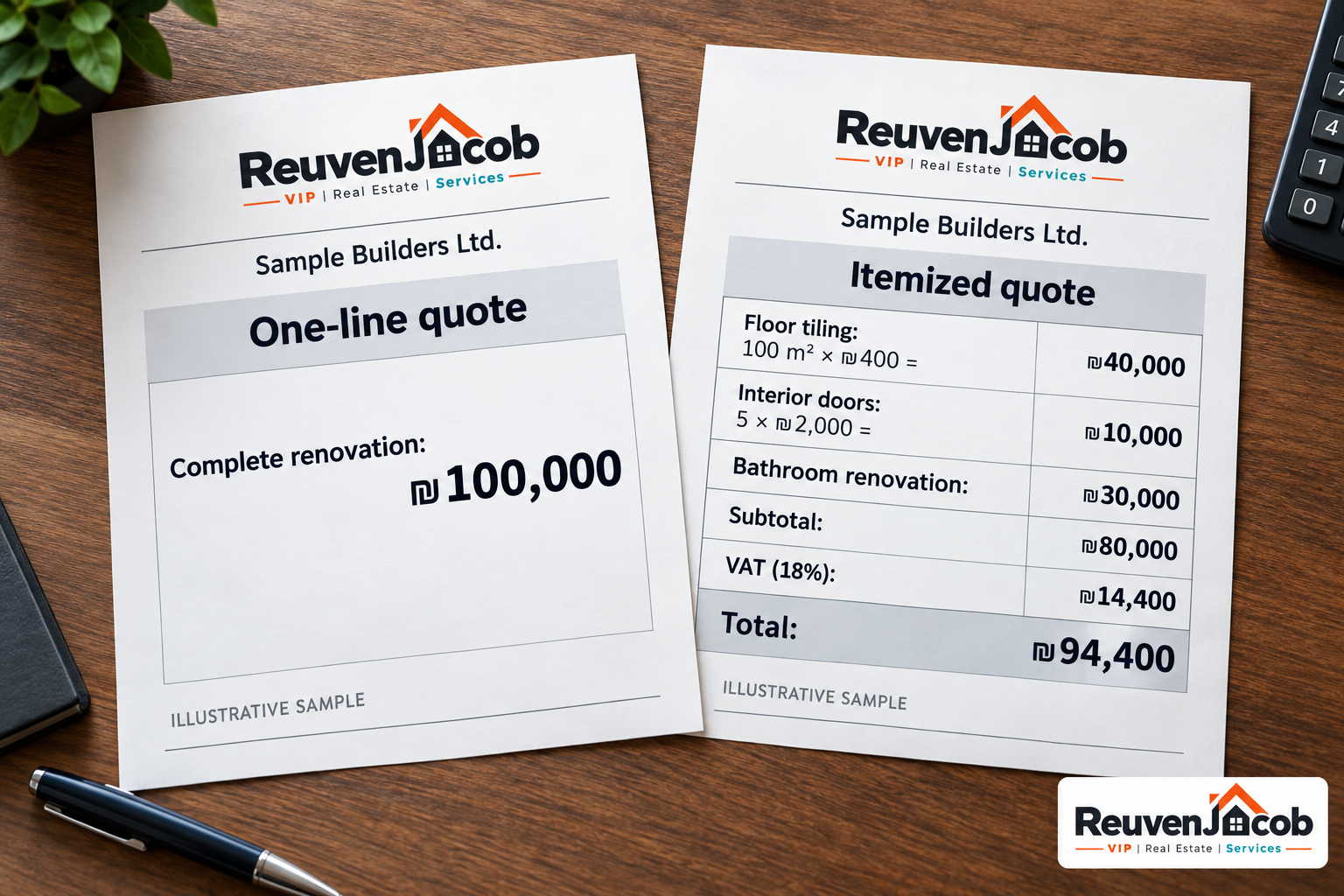
Three contractors, three quotes, three totals. The natural instinct is to compare the bottom lines and pick the lowest. Without matching the specifications, it can also leave you paying more than you expected.
Why? Because a total tells you what the contractor wants to be paid, not what you’re paying for. Once work starts and plans change, as they almost always do, a quote without detail leaves you negotiating every change from a position of weakness. Reuven Jacob has watched this happen to buyers across Beit Shemesh, and the protection is surprisingly simple: get the right information before you choose.
Start with a recommendation, not an advertisement
Start with contractors recommended by people whose judgment you trust. Then speak to recent clients about the finished work, the schedule, communication and how unexpected problems were handled. A glossy portfolio cannot answer those questions on its own.
If your Hebrew isn’t strong, make sure someone you trust can review the specification and communicate clearly with the contractor. A bilingual project manager can help keep decisions, changes and responsibilities understood by both sides.
Ask for the contractor’s registration details where registration is required for the type and scale of work, and check that the classification fits the project. The Ministry of Construction and Housing’s buyer guidance explains why a contractor’s professional and financial classification matters. Your project manager or lawyer can check the requirements for your particular renovation.
Bring the same plans, finish choices and specifications to each contractor. The clearer that shared starting point is, the easier it becomes to see what each quotation includes and where the differences lie.

Why a one-line quote is a red flag
Always get your quotation in writing. Then look at how it was built.
A quote that says the project will cost ₪100,000 and stops there is difficult to compare. Ask for a specification showing how that figure was reached: quantities, unit prices, materials, labor, disposal and any exclusions. Tiling should identify the area and the price per square meter. Doors should be priced individually, with supply and installation clearly separated. A bathroom should be broken down by the work actually included. Compare current quotes for the same specification rather than an old online price average.
With that level of detail, you’re no longer comparing three totals. You’re comparing quantities and unit prices, which is where real differences between contractors show up.
What happens when you change your mind?
This is where an itemized quote earns its keep.
Most renovations change along the way. You decide to tile another ten square meters, or you remove a window, or you add one. With an itemized quote, the agreed price-per-meter or per-item already applies. Without one, you’re at the mercy of whatever figure the contractor names, which can mean an unreasonable extra charge for additions or an unreasonably small credit for removals.
For each change, record the additional work or credit, its price, its effect on the schedule and your approval before work proceeds. An agreed unit price only helps if the contract says when it applies and both sides record the change.
The detail you collect before work starts is what protects you once it does.

Schedules, penalties and paying as you go
Price is only one part of the comparison. Look just as closely at each contractor’s commitment to the schedule, and at what happens if they miss it. A delivery date with no consequence attached is a hope, not a commitment.
Then look at the payment structure. Avoid paying too much in advance. Agree construction milestones and have completed work checked before releasing the corresponding payment. New-apartment purchases have a separate statutory framework for protecting buyers’ payments; a renovation contract needs its own carefully written payment, change-order and handover arrangements. Have your lawyer review those terms.
This matters more than many people realize. If a contractor walks away mid-project, finding a replacement is hard. No builder wants to take over someone else’s unfinished job, particularly once the plumbing, electrical or structural work has begun.
Guarantees, legal review and VAT
Before you sign, make sure three more things are in place:
- A guarantee. Know what the contractor will stand behind after the job is done, and for how long.
- A legal review. If possible, have a lawyer review the contract before you commit.
- VAT clarity. Confirm whether VAT (Ma’am) is included in the quoted price or will be added later. Israel’s standard rate has been 18% since January 2025 (PwC Tax Summaries), so on a ₪100,000 job, the difference is ₪18,000.
Put every payment in writing
Finally, every payment arrangement should be discussed, agreed and documented in advance: the amounts, the method and the milestone each one is tied to. Payments should be lawful, transparent and traceable. That record protects you if there is ever a dispute, and it keeps both sides working from the same understanding.
Sources and further reading
- Olim Toolbox Tip #72: Caveat Oleh!, The Jewish Link
- Registration and Classification of Contractors, Doron, Tikotzky & Co.
- Buying an Apartment on Paper: Protect Your Money, Nefesh B’Nefesh
- Israel: Other taxes (VAT at 18%), PwC Worldwide Tax Summaries
- VAT Updates for 2025, Herzog Fox & Neeman
- Related on this blog: Designing an Israeli Apartment That Works for a Large Family
Build with professionals you can trust
Reuven Jacob works with builders, project managers and renovation professionals he has known for years, and can connect you with people who provide detailed, written specifications from the start. Whether you’re renovating a new purchase or upgrading your current home, contact Reuven Jacob or call 052-561-0702 to find the right team for your project.
Join The Discussion