


 by
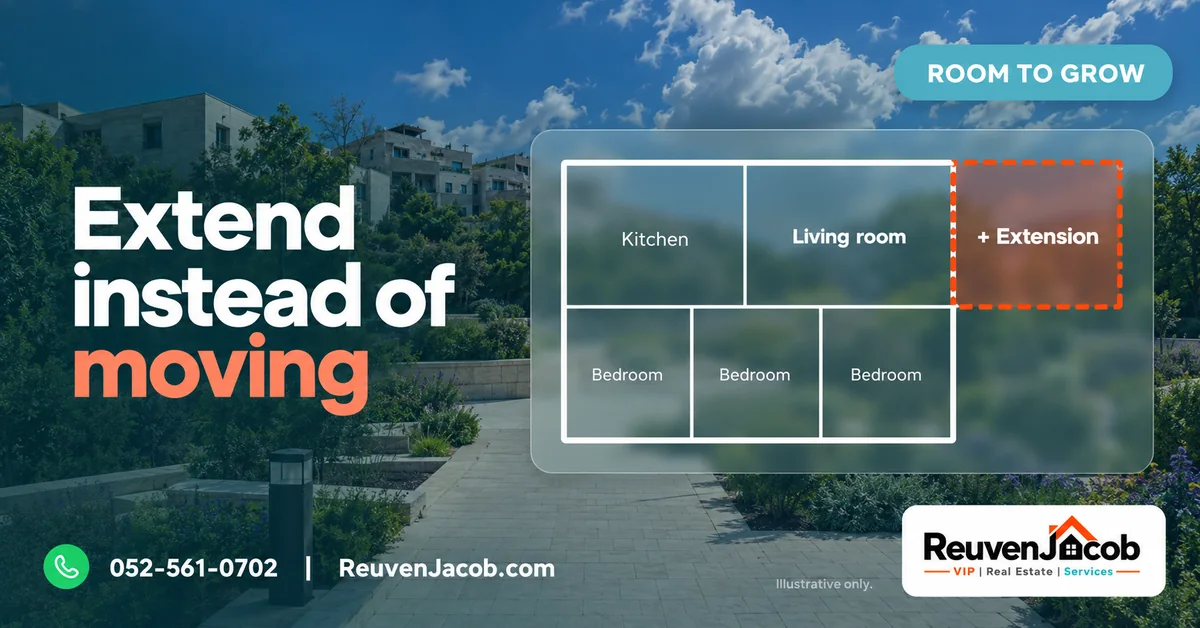
Families in Beit Shemesh rarely outgrow their neighborhood. They outgrow their apartment. The shul, the school, the neighbors and the carpool all still fit; the living room no longer does. The traditional answer has been to sell and move. Increasingly, families are asking a different question: can we add space where we already are?
In many cases the answer is yes. An extension is not a quick fix, and it is not right for every property. But when the building rights exist and the process is handled properly, it can be one of the most efficient ways to gain space in a city where larger homes are scarce. This guide explains how it works.
Extending Instead of Moving
Moving carries costs that never appear in a listing price: purchase tax, legal fees, brokerage, mortgage fees and the move itself. It can also mean leaving a community a family has spent years building.
An extension keeps those roots in place. The trade-off is time and planning. Talk is cheap; building rights are not. Everything depends on what the planning rules allow for your specific building.

Step 1: Confirm the Building Rights
Every plot in Israel is governed by a zoning plan (Taba) that sets how much may be built. According to Buy It in Israel, the building percentage (achuzei bniya) determines the total permitted construction, and these rights generally belong to the property as a whole rather than to an individual apartment. The plan for any address can be checked at the Beit Shemesh municipality’s planning department.
If no unused rights remain, the route becomes a change to the zoning plan. That process, Buy It in Israel notes, often takes 18 to 24 months in many cities, with no guaranteed outcome.
Step 2: Secure Your Neighbors’ Consent
In a shared building, an extension usually needs agreement from the other owners. According to an analysis by Shpak Law, owners of about 75% of the apartments can approve attaching part of the common property to a specific unit, while a lower threshold of 60% applies when the extension creates a mamad. Neighbors who believe their rights are seriously affected can still object, and disputes can go to the condominium inspector.
In practice, early and open conversations with neighbors save months later.
Step 3: Plan with an Architect
Just as you would not build a house without a blueprint, you should not extend one without plans that comply with the zoning rules. An architect who works regularly with the Beit Shemesh planning committee will know what is likely to be approved and how to design the new space so it feels original rather than added on. Our architects and interior designers can review a property before you buy.
Step 4: Apply for the Building Permit
The plans go to the local planning committee as an application for a building permit (heter bniya). Neighbors receive notice and may object. Once the permit is approved and its conditions are met, including fees and any betterment levy (hetel hashbacha), construction can begin. The betterment levy can add significant cost, so budget for it from the start.
Step 5: Build, Then Certify
Construction is the visible part of the process, but it is not the last step. Completion is confirmed through certificates that the work matches the permit, known as Tofes 4 and Tofes 5. Without them, the extension may not be fully recognized.
Step 6: Update the Records
The final step is updating the land registry and the condominium documents so the added space is formally part of the apartment. This protects its value when you refinance or eventually sell.
Extension Costs in 2026
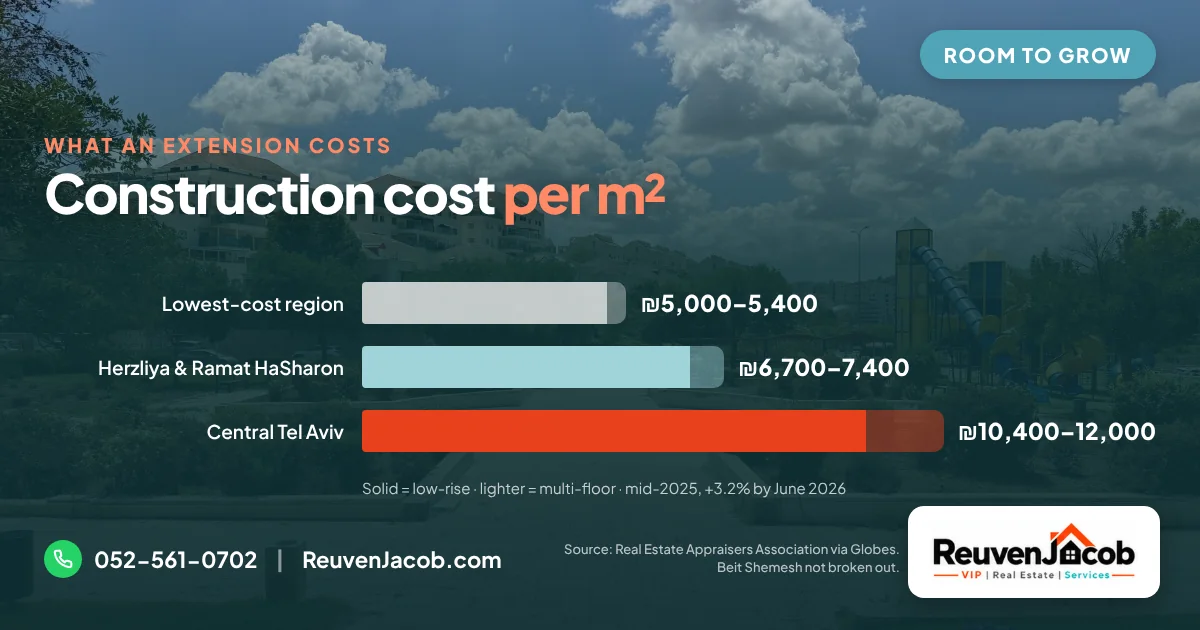
Costs vary widely by scope, finish and access. As a reference point, the Real Estate Appraisers Association construction cost estimate reported by Globes put low-rise construction at about ₪5,000 per m² in the lowest-cost region and about ₪10,400 per m² in central Tel Aviv in mid-2025. Beit Shemesh is not broken out separately. Since then, construction costs rose about 3.2% in the year to June 2026. Treat these figures as a starting point, and get written quotes before committing.
Financing is often more accessible than buyers expect. With the Bank of Israel rate at 3.25% after three cuts in 2026, it is worth discussing extension costs with a mortgage advisor at the same time as the purchase.
Risks and Practical Safeguards
- Building without a permit: the municipality can require the work to be undone, and a new owner is not protected simply by not having built it.
- Valuation: appraisers may give no value to illegal additions, which affects mortgages and resale.
- Neighbor disputes: skipping consent can lead to demolition claims, as the case reviewed by Shpak Law illustrates.
A Worked Example: Nachal Nachshon
The five-room garden apartment on Nachal Nachshon in RBS Aleph comes with an option to extend the living room, subject to permits. Combined with 130 m² of interior space, a 35 m² garden and a 45 m² balcony, that option allows a family to buy for today and build for tomorrow. It is newly reduced to ₪3,995,000. Read the full overview, and see our garden apartment buyer’s guide for the checks every garden property needs.
For the renovation side of the equation, see six lessons from a renovation done right.
Key Takeaways
- Building rights come first; everything else depends on them.
- Neighbor consent and a permit protect both the work and its value.
- Budget for the betterment levy and a contingency, not only for construction.
- An option to extend is worth verifying before you buy, not after.
Next Steps
- Talk to our building and renovation partners, or browse the Service Hub.
- Discuss financing with our mortgage and financial services partners.
- Call or WhatsApp Reuven Jacob on 052-561-0702 to view properties with room to grow.
Join The Discussion