
 by
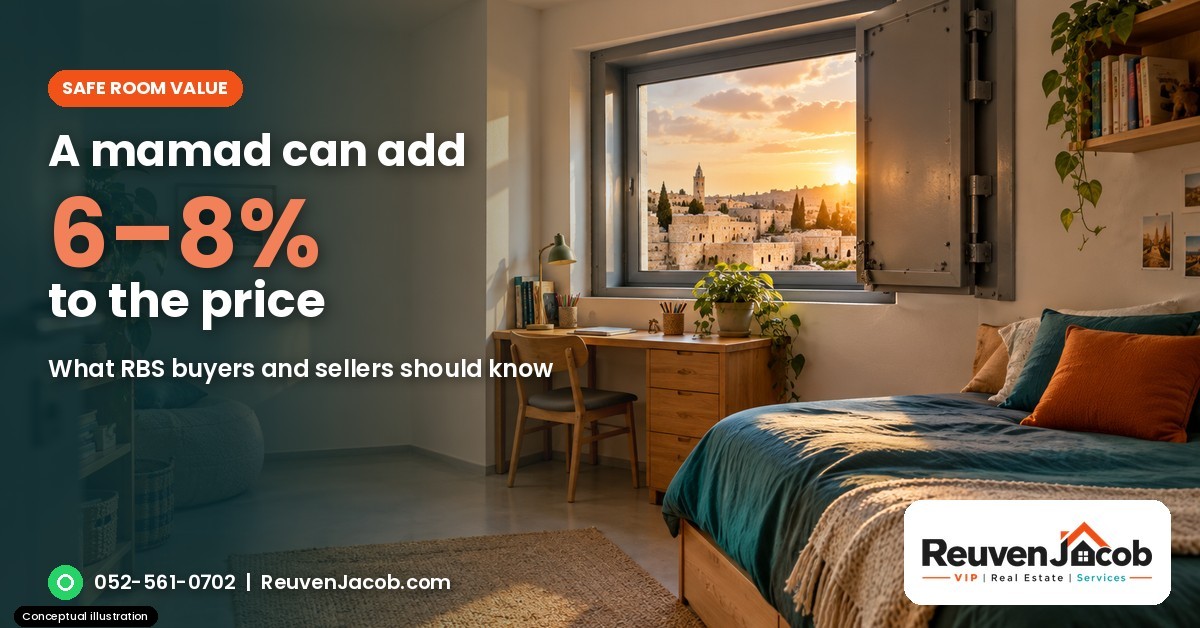
A generation ago, Israeli buyers asked about the view, the floor and the parking. Today the first question at many viewings is shorter: is there a mamad?
The shift isn’t just emotional. It shows up in prices, in rents and in how quickly an apartment sells. For buyers and sellers in Beit Shemesh, it’s worth understanding what a safe room is really worth, and what to do if your building doesn’t have one.
What Counts as a Safe Room?
Israeli homes are protected in one of three ways:
- Mamad (merchav mugan dirati): a reinforced-concrete room inside the apartment, with a blast door and a steel window shutter. Most families use it as a bedroom or study day to day.
- Mamak (merchav mugan komati): a protected space on each floor, shared by the apartments on that floor.
- Miklat: a communal shelter for the building, often in the basement, or a public shelter on the street.
The difference matters when the siren sounds. A mamad means seconds to safety without leaving your home. A communal shelter means stairs, neighbours and, at night, sleeping children.
How Common Are Mamads?
Less common than many newcomers assume. A building requirement for a safe room in every new apartment has applied since 1993, according to Buy It in Israel, which estimates that about 60% of apartments in Israel still have no mamad.
In Beit Shemesh, the picture depends on the neighbourhood. Much of Ramat Beit Shemesh was built after the requirement came in, so a mamad is standard in many buildings. Older parts of the city, and some early buildings, rely on floor or communal shelters. Never assume; always ask.
How Much Does a Mamad Add to Value?
The most careful figures come from the Bank of Israel. Economists Yossi Yakhin and Aya Talmon analysed about 99,000 deals since 2023, Globes reported. They found that apartments with a protected room sold at a premium of about 8.2% before 7 October 2023. That premium eased to around 6.4% by the end of 2024, and initial findings after the June 2025 operation against Iran suggested it rose to about 11%, though the researchers said it was too early to tell whether that would last.
The Real Estate Appraisers Association, in a study commissioned by Globes, found even wider gaps on a price-per-metre basis: about 20% in Tel Aviv and 19% in Haifa, Ashkelon and Nahariya, but a significantly smaller gap in Jerusalem.
What does this mean in practice? On a ₪3 million RBS apartment, a 6% to 8% premium is roughly ₪180,000 to ₪240,000. That is the price of an extra room.
What About Rents?
Tenants are paying for protection too. The same Bank of Israel research found that the rent premium for a protected room climbed after the war began, and from May to December 2024 it ran 3.7% to 4.1% higher than in the first nine months of 2023. The researchers suggested that renters, on shorter contracts, weigh current security conditions more heavily than buyers do.
For landlords in RBS, where demand for family-sized rentals is already strong, a mamad is one more reason a good apartment lets quickly.
No Mamad? What Are the Options?
An apartment without a mamad isn’t a write-off. It’s a different calculation.
- Price it in. If the apartment is otherwise right for you, the missing mamad should be reflected in the price, and in your plan for using the shared shelter.
- Check the building’s shelter. Where is it, how far is it, is it accessible, and is it maintained?
- Ask about adding one. In some buildings, a mamad can be added, sometimes as part of a wider urban renewal project. It needs an engineer, neighbours’ cooperation and the right approvals from the local planning committee.
- Follow the legislation. In July 2025 the Knesset passed a law letting owners in existing buildings of up to nine floors add 3 m² to a mamad and another 3 m² for a bathroom, exempt from betterment levy, as Nadlan Center reported (Hebrew). It was first proposed, as reported by Klikat Nadlan (Hebrew), as a way to let existing mamads grow by up to 6 m². Ask the local planning committee how it applies to your building.
Our guide to urban renewal in Beit Shemesh, coming in January, explains how renewal projects can add safe rooms to older buildings.
What Should You Check at a Viewing?
- Is it a real mamad? Look for the blast door, the steel shutter and the ventilation filter unit.
- Has it been altered? Removed doors, enlarged windows or extra openings can compromise it.
- Is it registered on the plans? Ask to see the approved building plans.
- How is it being used? A mamad that doubles as a bedroom counts in the room count; make sure the listing is clear.
- No mamad? Walk the route to the nearest shelter, at the pace of your slowest family member.
Looking Ahead
The mamad has gone from building code to selling point. For buyers, it’s a safety question first and a value question second, and both point the same way. For sellers, a well-kept mamad is an asset worth presenting clearly. For owners of older apartments, the next few years of legislation and urban renewal may open new options.
Reuven Jacob helps buyers and sellers in Beit Shemesh understand what really drives value in a home, mamad included. Call 052-561-0702 or learn more at reuvenjacob.com.
Join The Discussion