


 by

Buying a home in Israel looks familiar from the outside. There’s a seller, a price, a contract and a set of keys. Underneath, though, almost every step works differently from what Anglo buyers know from the US, UK or South Africa.
The agent doesn’t run the contract. Your protection comes from a note in the Land Registry. And the tax bill depends heavily on when you made, or will make, aliyah.
For olim, that last point is worth real money. So before you fall in love with a garden apartment in RBS Aleph or a new tower in Neve Shamir, here’s what you need to understand.
What Is the Tabu, and Why Does It Matter?
The Tabu is Israel’s Land Registry. It records who owns a property and what rights, mortgages and liens sit on it. Before you sign anything, your lawyer will check it for ownership, debts and liens, verify boundaries and review permits and plans, as Tel Aviv agent Noah Sander outlines in Ynet’s guide to the buying timeline.
However, not every Israeli home is registered there yet. According to Adv. Yair Aloni of Afik & Co., some homes are registered with the Israel Land Authority, which owns much of the country’s land and leases it out, and new buildings not yet registered at the Land Registry are recorded with the developer, usually through its law firm. Each route can protect you. Each also needs to be checked.
The key protection is the cautionary note, or he’arat azhara. Aloni explains that “by recording a cautionary note one puts the public on notice of the transaction,” which guards you against the seller selling twice or the seller’s creditors stepping in. Your lawyer should register it right after signing.
Why Do You Need Your Own Lawyer?
In Israel, the lawyer is the centre of the deal. As Sander puts it, it is “the lawyer, not the realtor, who executes the contract.”
Your lawyer checks the title, negotiates and drafts the contract, registers the cautionary note, files purchase tax and completes the final registration. For a new-build purchase, they also review the developer’s permits, specifications and bank guarantees.
Unfortunately, some buyers try to save money by sharing the seller’s lawyer. Don’t. Hire an English-speaking real estate lawyer who represents only you. If you’re buying from abroad, Ynet notes you can sign through a power of attorney, so arrange one early.
How Much Purchase Tax Will an Oleh Pay?
This is where aliyah status makes the biggest difference. Purchase tax (mas rechisha) is paid by the buyer, and since 15 August 2024 olim have had a new, much more generous track.
According to Nefesh B’Nefesh’s purchase tax guide (last updated 15 April 2026), the oleh rates are:
| Price band (NIS) | Oleh rate |
|---|---|
| Up to 1,978,745 | 0% |
| 1,978,745 – 6,055,070 | 0.5% |
| 6,055,070 – 20,183,565 | 8% |
Compare that with the regular single-home rates on the same page: 0% up to NIS 1,978,745, then 3.5%, then 5% from NIS 2,347,040. A non-resident or someone buying an additional home pays 8% from the first shekel. On a NIS 3 million apartment in RBS, the oleh rate works out to roughly NIS 5,100. The regular first-home rate would be closer to NIS 45,000.
The conditions matter just as much as the rates:
- Timing. NBN says the benefit applies to purchases signed up to a year before aliyah or within seven years after it. Time in the army doesn’t count toward the seven years.
- Once only. Globes reported that the benefit under the new regulation “is given once only.”
- Single residence. NBN notes that since August 2024 the new rates apply only where it is the oleh’s single residence, though the oleh doesn’t have to live in it.
- Price cap. Purchases above NIS 20,183,565 don’t qualify.
Brackets are index-linked and the rules have changed before. Confirm the current figures and your eligibility with your lawyer before you sign. This is not legal or tax advice.
How Much Can You Borrow?
Mortgage limits in Israel are set by the Bank of Israel, and your status changes the answer. The Bank of Israel’s LTV rules allow first-time buyers to finance up to 75% of the home’s value, upgraders up to 70%, and owners of more than one home up to 50%.
For olim, Mizrahi-Tefahot Bank puts it simply: “You are entitled to up to 75% LTV (loan to value) instead of 50% as a foreign citizen.” The same page notes the Bank of Israel caps the monthly repayment at 40% of net household income.
What does this mean in practice? A buyer who hasn’t yet made aliyah should plan on a 50% deposit. After aliyah, the same family may need only 25%. That gap can decide whether you buy before or after you land, so speak to a mortgage broker early.
How Should You Move Your Money?
If your savings are in dollars or pounds, the exchange rate is part of your purchase price. Nefesh B’Nefesh’s money transfer guide makes several practical points:
- Wires are generally the most convenient route for large sums.
- Banks and private brokers set their own rates and aren’t bound by the Bank of Israel’s official rate, so bank rates are negotiable.
- Deposits above NIS 50,000 are reported to the tax authorities, and banks may ask for proof of the source of funds.
- If you use a currency broker, check that it is licensed by the Israeli Capital Market Authority.
In essence, prepare your paperwork before the money moves. A wire held up by a compliance check can delay a contract payment, and Israeli contracts take late payments seriously.
Does the Apartment Have a Mamad?
For many families, this has moved from a nice-to-have to a deal-breaker. According to Ynet, after the June 2025 war with Iran, homebuyers now rank safe rooms above balconies, parking and sunlight.
Adding one later is neither quick nor cheap. Ynet reported that a built-in safe room can cost up to NIS 180,000, and that in a multi-storey building, adding them requires unanimous owner consent and simultaneous construction across units. Planning law expert Hila Revach summed it up: “The main barrier isn’t permits—it’s cost.”
In practice, that’s one reason new projects in Neve Shamir appeal to so many olim. In older buildings, ask whether there’s a mamad, a shared miklat, or a realistic plan to add protection.
How Do Agent Fees Work?
Israeli law protects buyers here. Under the Real Estate Brokers Law, as Ynet explained, an agent must be licensed and is not entitled to a fee unless the client signed a written order. That order must list the property, the price and the agreed fee, and state whether VAT is included.
The fee itself is whatever you and the agent agree in writing, and in Israel it is common for buyers as well as sellers to pay one. Read the order before you sign it, and ask questions. A good agent will welcome them.
How Long Does the Whole Process Take?
According to Ynet’s timeline guide:
- Offer and negotiation. Agree price and basic terms; the agent passes details to the lawyers.
- Due diligence. Your lawyer checks the Tabu, permits and plans.
- Mortgage approval. Pre-approval takes about 1 to 1.5 weeks, and the bank appraisal several days to two weeks.
- Signing. A first payment of typically 10–30%, then the cautionary note is registered.
- Purchase tax. Ynet says it “must be paid within 60 days to avoid penalties.”
- Keys and registration. Final payment, then registration in your name.
For a secondhand home, that’s about two to three months from offer to keys. For new construction, it’s typically 24 to 36 months once building starts. Confirm deadlines for your specific deal with your lawyer.
Your Pre-Purchase Checklist
- Confirm your aliyah date and whether the purchase falls inside the oleh purchase tax window
- Get mortgage pre-approval based on your status (oleh or foreign resident)
- Hire your own English-speaking real estate lawyer
- Arrange a power of attorney if you’ll sign from abroad
- Open an Israeli bank account and gather source-of-funds documents
- Plan your currency conversion and transfer route
- Ask about the mamad or nearest shelter
- Read and sign the agent’s written order before viewings
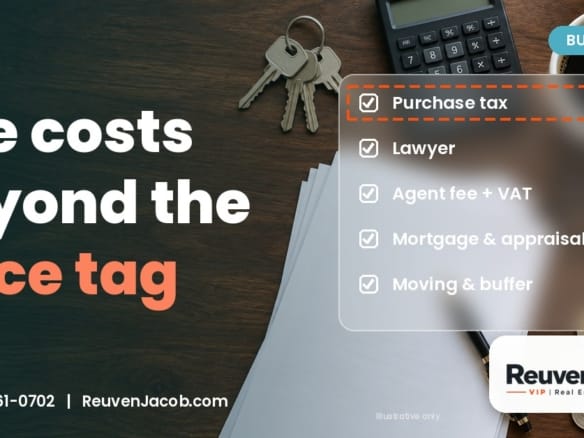
- Budget for purchase tax, legal fees, agent fees, appraisal and moving costs
Looking Ahead
The rules can look like a maze at first. Fortunately, each one has a clear purpose, and with the right team they work in your favour, especially if you’re an oleh. Handled well, a purchase in Beit Shemesh becomes a launchpad for your new life, not a source of stress.
If you’re planning aliyah or have just arrived, we’re happy to talk it through, together with the mortgage brokers we work with. Call 052-561-0702 or learn more at reuvenjacob.com.
Sources
- Ynetnews: From dreams to keys: the timeline of buying property in Israel, 6 Nov 2025
- Afik & Co.: Registration of a Cautionary Note, 11 Nov 2015
- Nefesh B’Nefesh: Planning Your Aliyah: Purchase Tax, updated 15 Apr 2026
- Globes: New tax benefit eases home purchase for immigrants to Israel, 25 Aug 2024
- Bank of Israel: LTV limits and borrower risk, 17 Dec 2018
- Mizrahi-Tefahot Bank: Q&A, mortgages in Israel for new immigrants
- Nefesh B’Nefesh: Money Transfer and Currency Conversion, modified 14 May 2026
- Ynetnews: Safe room rush: Israelis seek private sheltering solutions after Iran war, 26 Jun 2025
- Ynet (Hebrew): When do you pay brokerage fees?, 13 Aug 2003
Join The Discussion