


 by
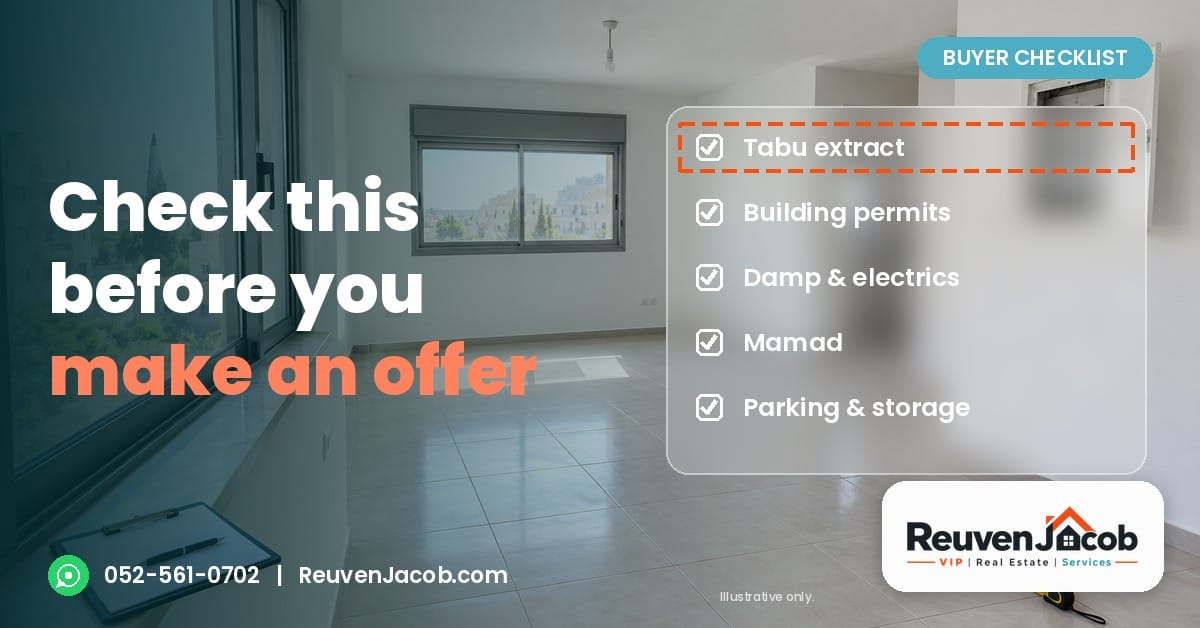
Falling in love with an apartment takes ten minutes. Finding out what’s wrong with it can take ten years, unless you check first.
For Anglo buyers in Beit Shemesh, the gap between those two moments is where most expensive surprises hide. In the US or UK, a buyer’s offer usually comes with inspections and title insurance built in. In Israel, much of that work is your responsibility, and much of it should happen before you commit. A little homework before you make an offer can save you money, stress and, in some cases, the deal itself.
Why Check Before the Offer, Not After?
In practice, Israeli deals move quickly from handshake to signed contract. Once you sign, a warning note is registered and money changes hands. Nefesh B’Nefesh’s guide to buying also cautions that many lawyers advise against signing a zichron devarim, the one-page memorandum some sellers request, because it can create binding obligations.
Talk is cheap. Signatures aren’t. The checks below help you decide whether to offer, and at what price, while you still have every option open.
What Does the Tabu Extract Tell You?
Start with the paperwork. The nesach tabu, or Land Registry extract, is the official record of who owns a property and what is registered against it. You can order one through the Ministry of Justice’s online service.
According to a 2026 guide from Merkaz HaNadlan, the extract shows:
- Ownership. The owner’s name and ID number, and whether the seller holds full ownership or a long-term lease.
- Mortgages and liens. Bank mortgages, attachments (ikulim), inheritance matters and easements.
- Warning notes (he’arot azhara). Registered commitments, such as an earlier buyer’s note or a restriction on selling without someone else’s consent.
- Attached areas. A garden, storage room or parking space registered to the specific apartment.
The same guide puts the online fee at NIS 15. It also notes that some properties aren’t registered in the Tabu at all, often because the builder hasn’t finished registering the building. In that case, the seller’s rights are checked with the Israel Land Authority or the developer’s lawyer instead. That’s common in newer parts of RBS, so ask early.
One detail matters more than buyers expect. If the listing promises parking or a machsan, check that it’s actually registered to that apartment. A storage room “everyone uses” isn’t the same as one you own.
Does What You See Match What Was Approved?
The Tabu tells you who owns the apartment. It doesn’t tell you whether the apartment was built legally. For that, you need the building file (tik binyan) and approved plans at the Beit Shemesh municipality’s engineering department, ideally reviewed by your lawyer or an architect.
This matters in RBS, where enclosed balconies, extended kitchens, garden rooms and converted storage spaces are common. Some were built with permits. Some weren’t. Attorney Yaacov Epstein, writing in The Jewish Link, warns that “even slight external renovations require a permit,” and that seemingly harmless extra space can be a “real building offense.”
Unfortunately, the problem doesn’t stay with the seller. Epstein explains that authorities can pursue a new owner who bought with a violation, and that a demolition order can still be enforced after a sale. Unapproved space can also lower the bank’s appraisal, which can shrink the mortgage you were counting on.
The building file also shows unused building rights. If you’re hoping to extend later, find out now what the plan actually allows.
Has the Mamad Been Touched?
For many RBS families, the mamad doubles as a bedroom or office. That makes it tempting to renovate. But a safe room is a structural, regulated space, not just another room.
In February 2026, Ynet reported on buyers who sued a Tel Aviv seller, alleging he removed a reinforced blast wall protecting the entrance to the apartment’s safe room without approval from the Home Front Command or the local planning committee. The buyers had already paid a NIS 700,000 deposit. The claims haven’t been decided in court, but the lesson is clear. Ask whether the mamad’s walls, door, window or vent were altered, and get any changes checked.
What Is Hiding Behind the Paint?
Think of an apartment like a house of cards. A fresh coat of paint can make it look solid, but the trouble usually sits underneath. In Beit Shemesh, three issues come up again and again:
- Damp and leaks. Look for bubbling paint, mould in corners, staining under windows and around bathrooms, and signs of water from the roof or the apartment above. Winter rain is the honest test.
- Electrics. Older buildings in Beit Shemesh weren’t wired for multiple air conditioners, an oven and a hot plate on Shabbat. Check the panel’s capacity and whether the wiring has been updated.
- Plumbing and the dud. Ask how old the water heater and pipes are, and whether the solar system works.
A professional inspector (bedek bayit) can find what a viewing can’t. It’s a small cost against a large purchase.
What Will the Building Cost You Each Month?
The price isn’t the only number. Ask the seller for recent arnona bills, and ask the municipality how the apartment is classified, so you know what you’ll pay.
Then meet the vaad bayit. Nefesh B’Nefesh advises consulting the building committee before signing, and checking for costly external management or pending repairs. A roof waterproofing project or an elevator replacement can land on you a month after you move in. NBN also recommends confirming that the seller has paid all taxes and utility bills before the transfer.
Your Pre-Offer Checklist
So how can you turn all of this into action? Before you make an offer:
- Order the Tabu extract and check ownership, mortgages, liens and warning notes.
- Confirm registration status. If it isn’t in the Tabu, check with the Israel Land Authority or the developer’s lawyer.
- Verify parking and storage are registered to the apartment, not just used by it.
- Review the building file at the Beit Shemesh engineering department for permits and approved plans.
- Identify any additions (balconies, rooms, gardens, storage) and whether each one was approved.
- Ask about the mamad and any changes to its walls, door or window.
- Book an inspection for damp, leaks, electrics and plumbing.
- Meet the vaad bayit about monthly fees, debts and planned works.
- Check arnona classification and recent bills.
- Brief your lawyer early. As Tel Aviv agent Noah Sander writes in Ynet, the buyer’s lawyer conducts due diligence before signing, checking the Tabu, debts and liens, boundaries and all building permits and plans.
This checklist isn’t legal advice. Your lawyer should confirm every point for the specific property.
Looking Ahead
Average home prices in Israel are down 1.8% year on year, and developers are sitting on a record supply of unsold new housing, according to The Times of Israel. In a calmer market, buyers have more time to ask the right questions. Use it. A well-checked apartment isn’t just safer to buy. It’s easier to finance, easier to renovate and easier to sell one day.
If you’re looking in Beit Shemesh, Reuven Jacob has spent over 20 years helping Anglo buyers find, check and buy homes in RBS Aleph, Rama Gimmel and Neve Shamir, working with trusted lawyers, mortgage brokers, architects and builders. Call 052-561-0702 or learn more at reuvenjacob.com.
Sources
- Nefesh B’Nefesh: A 10 Step Guide to Purchasing a Home in Israel, updated 4 Jun 2026
- Gov.il (Ministry of Justice): Generation of a Land Registry Extract (Tabu Extract)
- Merkaz HaNadlan: Tabu extract, the complete guide for 2026 (Hebrew), 10 May 2026
- The Jewish Link: Buying an Apartment in Israel With a Building Offense: Risk Assessment, Adv. Yaacov Epstein, 14 Jun 2018
- Ynet: Buyers sue seller for hiding dangerous construction violations in Tel Aviv luxury tower, 4 Feb 2026
- Ynet: From dreams to keys: the timeline of buying property in Israel, 6 Nov 2025
- The Times of Israel: Housing snapshot October 2026, 30 Oct 2026

Join The Discussion